
Study on CO2-neutral state administration published
On behalf of the Hessian Ministry of HMLU, ifeu has investigated how the state administration can achieve its climate policy goals by 2030. To this end, ifeu has developed various scenarios that show which measures are necessary to significantly reduce the state administration's greenhouse gas emissions and achieve a net greenhouse gas-neutral administration in the long term. The analysis also provides important insights into costs, energy-saving potential, and the role of compensation strategies.

Current market analysis on energy services published
Since 2015, the Federal Agency for Energy Efficiency (BfEE) has been working with a consortium consisting of Prognos AG, the ifeu Institute and Verian to regularly examine the markets for energy consulting, energy management and energy contracting in Germany. The results of the analysis for 2024 were presented and discussed on 14 October 2025 in Berlin at an in-person event with selected experts. The presentation slides are available for download. You can watch the presentation on YouTube.

Transformation hub: Namibia as a hydrogen pioneer
ifeu welcomes experts to discuss opportunities, challenges, and sustainability For the third “Treffpunkt Transformation” event, we welcomed Dr. Ludger Eltrop and his doctoral student Tobias Schließ from the Institute for Energy Economics and Rational Energy Use (IER) at the University of Stuttgart as speakers. In their presentation on “Hydrogen Production in Namibia,” they introduced various projects in Namibia, focusing on the DAURES Green Hydrogen Village project, and placed it in the global context of a developing hydrogen economy.

HIBISCUS - Bio-based innovations for building envelopes
Twelve European partners from research and technology organisations, SMEs and industrial groups met for a successful kick-off meeting for the European research and development project HIBISCUS, which was officially launched in September 2025. The project goal: aims to develop new bio-based construction materials to reduce dependence on fossil resources and contribute to the objectives of the Green Deal and the bioeconomy strategy of the European Union. Koordiniert wird das Projekt von Soprema, einem französischen Baustoffkonzern. Das ifeu übernimmt die integrierte Nachhaltigkeitsbewertung und setzt den „Safe and Sustainable by Design“-Ansatz (SSbD) um, um die Sicherheit und Umweltverträglichkeit der HIBISCUS-Produkte über den gesamten Lebenszyklus zu gewährleisten.

Discussion paper ‘Future Standard for Old Buildings’ published – How we can accelerate building renovation and make it fairer
The energy-efficient renovation of existing buildings is a key component in achieving climate targets. However, the current federal subsidy programme for efficient buildings (BEG) is reaching its limits: high costs, complex requirements and social inequalities are slowing down energy-efficient renovations. How can the renovation rate be increased without losing sight of efficiency and social justice? The discussion paper published today by Martin Pehnt (ifeu) and Thomas Auer (TU Munich) provides concrete proposals on how BEG funding can be made leaner, fairer and more effective – without sacrificing the quality of the renovation.

A new emissions trading scheme for buildings and transport – TREFFPUNKT TRANSFORMATION with Dr. Jana Nysten
Yesterday evening, we welcomed Dr. Jana Nysten from the Environmental Energy Law Foundation to the ifeu Institute in Heidelberg for an exciting lecture as part of our lecture series ‘Meeting Point Transformation – Future Knowledge at ifeu’ on ‘Emissions Trading System 2’. The next event, ‘Meeting Point Transformation – Future Knowledge at ifeu’, will take place on Thursday, 4 December. We look forward to welcoming speaker Dr Ludger Eltrop from the Institute for Energy Economics and Rational Energy Use at the University of Stuttgart. Registration and further information: www.ifeu.de

Distorted incentives for the drive system transition: greenhouse gas quota disadvantages battery trucks
The current structure of the greenhouse gas reduction quota (GHG quota) creates distorted incentives in road freight transport. A new study by the German Institute for Economic Research (DIW Berlin) in collaboration with ifeu concludes that this policy instrument for reducing greenhouse gas emissions disadvantages energy-efficient battery-electric trucks compared to trucks with hydrogen fuel cells. This leaves untapped potential for the ramp-up of battery-electric drives and climate protection in road freight transport. Road freight transport is responsible for one third of transport emissions in Germany. Emission-free vehicles are therefore central to the path towards climate neutrality. So far, they have played only a minor role in heavy goods transport, but have recently seen significant growth, especially in battery-electric trucks.
Boosting living space in existing single-family homes instead of consuming greenfield sites
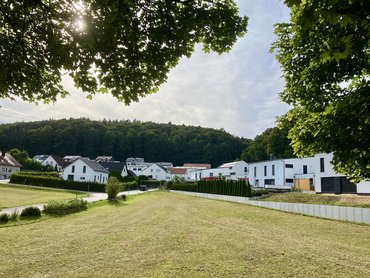
Anyone who has ever looked for a flat in Germany's urban centres knows that finding accommodation is difficult and often unaffordable, even with an average or even ‘good’ salary. In response to this, the Bundestag and Bundesrat passed the so-called ‘Bauturbo’ (construction turbo) in October, promising faster approvals and procedures, especially for new buildings, but also for conversions. In line with this, ifeu, on behalf of the Federal Association for Housing and Urban Development (vhw), is providing local authorities with additional, effective recommendations for action on creating living space in (unused) single-family homes.

Global biodiversity loss – How the EU can promote environmentally friendly consumption
According to Eurostat (2024), the consumption footprint of people in Europe is 14 tonnes of material per capita. The United Nations Environment Programme says the target should be 5.5 to 8 tonnes. This consumption contributes to global biodiversity loss, especially in the Global South. A new study by the Institute for Ecological Economy Research (IÖW) and the Institute for Energy and Environmental Research Heidelberg (ifeu) highlights the role of soy, palm oil and shrimp production. The researchers make recommendations for EU policy in line with biodiversity conservation goals. This week, the results of the study ‘Towards nature-friendly consumption’, commissioned by the Federal Agency for Nature Conservation (BfN), were discussed at an online conference with international experts.